
本研究班によるスコーピングレビュー「Iatrogenic cerebral amyloid angiopathy: a scoping review」が、Journal of Neurology, Neurosurgery and Psychiatry(JNNP)に掲載されました(2026年8月14日オンライン公開)。
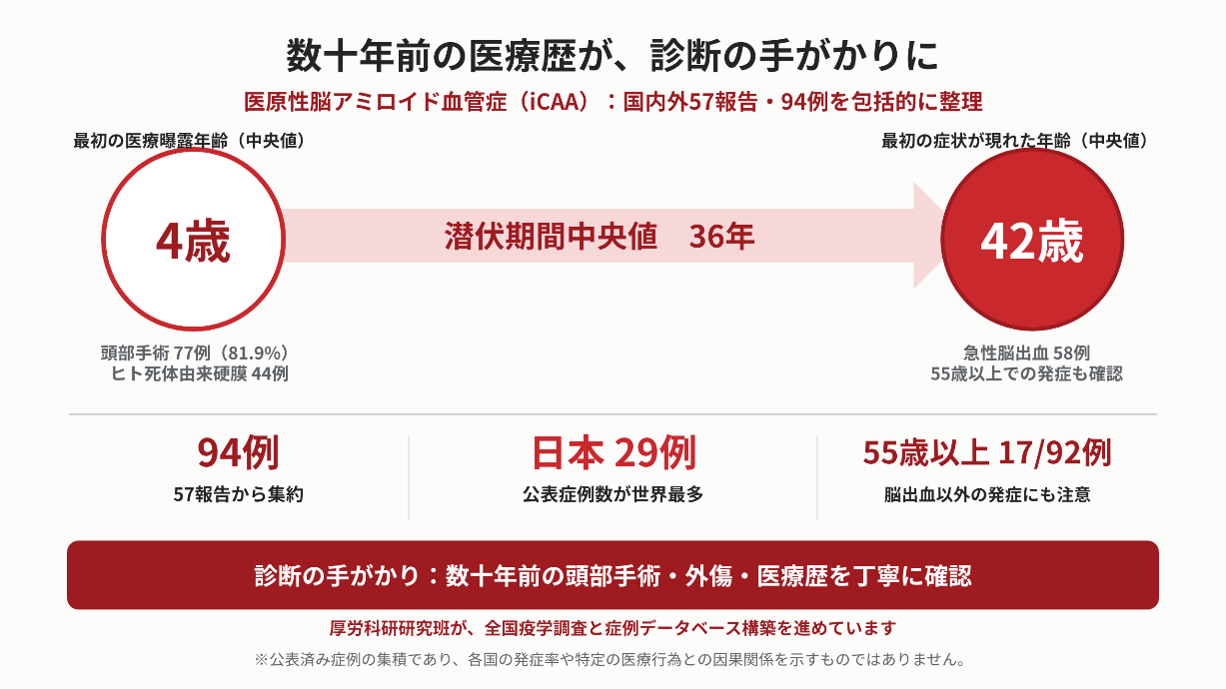
研究の概要
医原性脳アミロイド血管症(iCAA)の報告例は近年増加していますが、報告の地域分布や、発症年齢による臨床像の違いはこれまで体系的に整理されていませんでした。本研究では、PRISMA-ScR(スコーピングレビューの報告ガイドライン)に沿って、MEDLINE、Scopus、医中誌Webを各データベースの収録開始時から2026年1月31日まで検索し、既報のiCAA症例を網羅的に収集しました。収集した症例は改訂Queen Square基準に基づいて後方視的に分類し、世界的な分布と臨床的特徴をまとめました。
主な結果
- 57報・94例を解析対象としました。
- 報告症例数は日本が最多でした(ただし症例数から発生率を推定することはできません)。
- 初発時年齢の中央値は42歳、初回曝露時年齢の中央値は4歳で、潜伏期間の中央値は36年でした。
- 主な曝露は脳外科手術で、44例でヒト屍体由来硬膜の使用が確認されました。
- 94例中58例が急性脳出血で初発しました。一方、55歳以上で発症した例では、初発時の急性脳出血の頻度が低い傾向がみられました。
本研究の意義
iCAAは55歳以降にも発症し、また急性脳出血を伴わずに発症しうることが示されました。脳アミロイド血管症が疑われる患者では、年齢にかかわらず幼少期の脳外科手術歴などの曝露歴を系統的に聴取すること、そして国際的に連携したレジストリによるサーベイランス体制を構築することの重要性が示唆されます。なお、症例の把握や出版のバイアスがあるため、本結果から国・地域間の発生率を比較することはできません。
書誌情報
Iatrogenic cerebral amyloid angiopathy: a scoping review
Ikeda S, Hamaguchi T, Hirano T, Yagita Y, Koga M, Ihara M, Nakajima M, Itabashi R, Shindo A, Kudo K, Saito N, Sekijima Y, Kouda K, Murakami A, Inutsuka R, Sekiguchi K, Kosami K, Ae R, Ono K, Fujimoto S, Yakushiji Y*
J Neurol Neurosurg Psychiatry. 2026 (Online ahead of print, Aug 14, 2026)
DOI: 10.1136/jnnp-2026-339381 PMID: 42601217
*責任著者
English summary
Our scoping review of published iatrogenic cerebral amyloid angiopathy (iCAA) cases has been published in the Journal of Neurology, Neurosurgery and Psychiatry. Following PRISMA-ScR, we searched MEDLINE, Scopus and Ichushi-Web up to 31 January 2026 and identified 57 reports describing 94 cases, classified according to the revised Queen Square framework. Japan contributed the largest number of published cases. The median ages at first exposure and first presentation were 4 and 42 years (median latency, 36 years); cranial surgery was the main exposure, with cadaveric dura mater identified in 44 cases. Acute intracerebral haemorrhage was the first presentation in 58 cases but was less frequent among patients with onset at age 55 or older. These findings support systematic ascertainment of exposure history and internationally coordinated, registry-based surveillance.